A timber report says twelve percent moisture content. Another sheet describes the same specimen as approximately 10.7 percent water. Before assuming that a meter failed or the wood changed, check the denominator. Moisture expressed relative to dry wood and moisture expressed relative to the whole wet specimen produce different percentages from the same masses.
This distinction is useful when reading building records, material specifications and research on surfaces. It also illustrates a broader rule: a percentage is incomplete until you know what the quantity is divided by. The word “moisture” alone does not identify the measurement basis, the instrument or the conditions under which a number was obtained.
Start with a mass balance
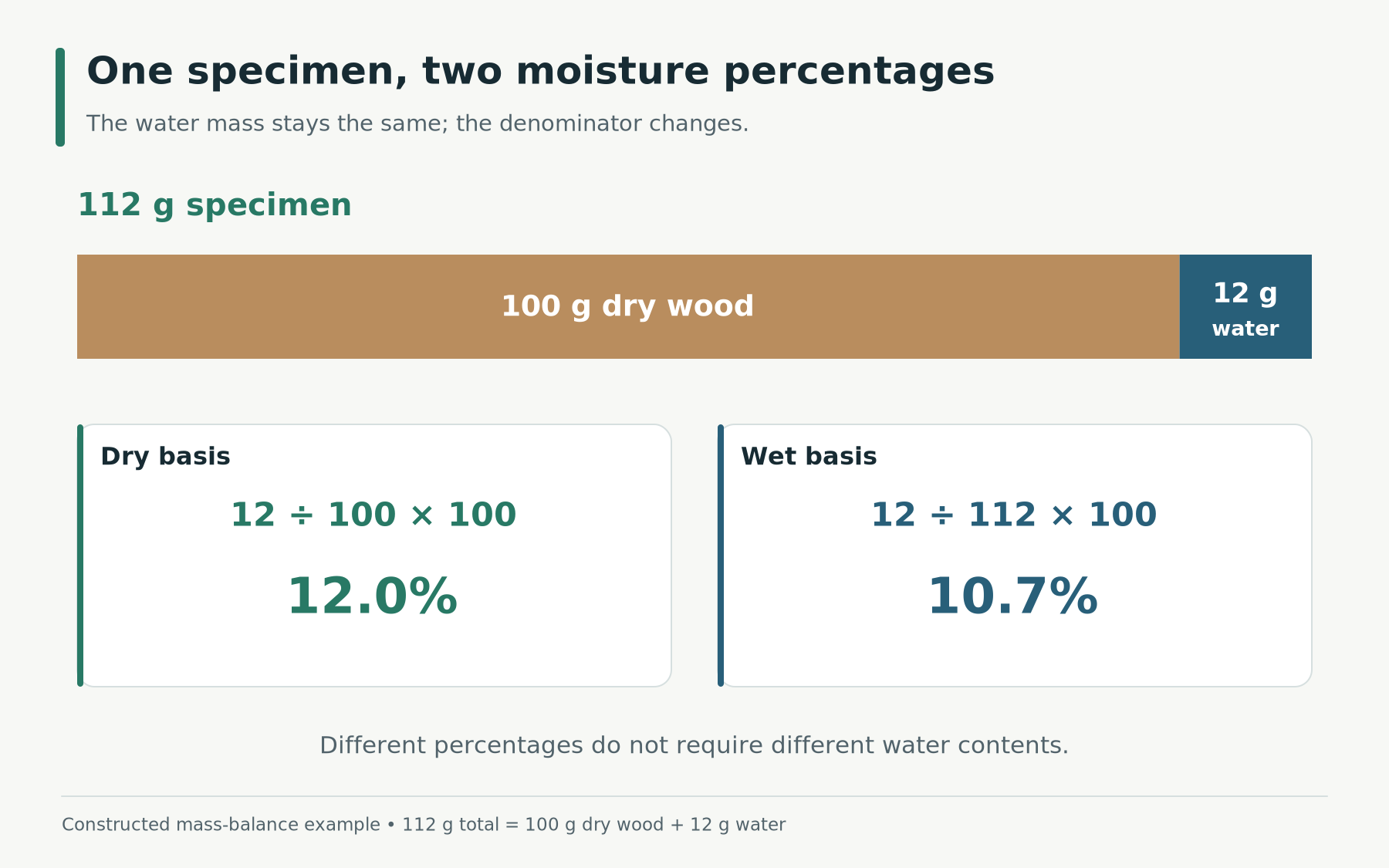
Imagine a fictional wood specimen whose current mass is 112 grams and whose dry reference mass is 100 grams. The difference is twelve grams of water. The arithmetic describes the specimen, not a recommended condition for building with it. No universal acceptance limit follows from this example.
Dry-basis moisture content divides water mass by dry material mass. Here, twelve divided by one hundred, multiplied by one hundred, gives twelve percent. Wet-basis moisture content divides water mass by the specimen’s total current mass. Twelve divided by 112, multiplied by one hundred, gives approximately 10.714 percent.
| Quantity | Calculation | Result |
|---|---|---|
| Water mass | 112 − 100 | 12 g |
| Dry-basis moisture | 12 ÷ 100 × 100 | 12.0% |
| Wet-basis moisture | 12 ÷ 112 × 100 | 10.7%, rounded |
The USDA Forest Service’s Wood Handbook chapter on moisture relations explains wood–water relationships and the physical properties associated with them. When reading a timber document, use its definition rather than assuming that a familiar percentage always has the same denominator. A supplier’s table and a fuel-handling document may use different conventions.
Convert the basis without changing the specimen
For another quick check, twenty percent dry-basis moisture corresponds to approximately 16.7 percent wet-basis moisture. Comparing the original twenty with a wet-basis value of eighteen would reverse their apparent order unless the bases were harmonised first. Convert comparable quantities to the same definition before ranking them. Keep the original columns too, so another reader can verify the conversion and see which values were supplied rather than calculated.
If the dry-basis percentage is D, the corresponding wet-basis percentage is one hundred times D divided by the sum of one hundred and D. For D equal to twelve, the calculation is 1,200 divided by 112. It reproduces the 10.714 percent value because the wet mass includes both dry wood and water.
To reverse the conversion, let W be the wet-basis percentage. The dry-basis percentage is one hundred times W divided by the difference between one hundred and W. Use the unrounded value when available. Converting a rounded 10.7 percent back produces a small rounding difference, not evidence that water appeared or disappeared.
An EPA background document for wood products explicitly gives both dry-basis and wet-basis definitions. That makes it a useful reference when two reports appear inconsistent. The conversion changes how the same water content is expressed; it is not a drying calculation or a prediction of how quickly a building material will change.
Why dry-basis values can exceed one hundred percent
A percentage above one hundred can look impossible if you imagine every percentage as a fraction of the whole. But dry-basis moisture uses dry wood as its reference, not total wet mass. In a second fictional specimen, fifty grams of dry material plus seventy-five grams of water gives a total of 125 grams.
Its dry-basis moisture is 150 percent, because seventy-five is one and a half times fifty. Its wet-basis moisture is sixty percent, because seventy-five is sixty percent of 125. Both figures describe the same mass balance. The apparent paradox disappears once the denominator is written beside the number.
This example is deliberately arithmetic. It is not a claim that a particular structural component normally contains that amount of water. A useful explanation separates a mathematically possible reporting value from the material, condition and application being discussed. Otherwise an illustration can accidentally be mistaken for a building specification.
A meter reading is not a direct weighing
A moisture meter estimates a property through its measurement method and calibration. Its display should therefore be read with the instrument’s material setting, limitations and reporting convention in mind. A percentage appearing on a screen does not mean that somebody directly weighed the water inside that exact spot.
For an inspection record, preserve the instrument identification, the location examined and the material setting alongside the reading. A value from one surface position is not automatically representative of an entire beam. Comparing readings from different methods without noting those differences can create a false impression of precise agreement or disagreement.
Do not convert a relative scale into a percentage merely because both use numbers. If an instrument reports an index, retain that label. Converting between wet and dry bases is appropriate only when the starting value is actually a moisture-content percentage with a known definition. Arithmetic cannot supply missing measurement information.
Keep three water-related quantities distinct
Wood moisture content, room relative humidity and water activity describe different things. Moisture content concerns water associated with the material relative to a specified mass. Relative humidity concerns air. Water activity concerns the availability of water in a thermodynamic sense. They can be related under particular conditions, but their percentages or values are not interchangeable labels.
A room humidity reading therefore cannot simply be pasted into the moisture-content field of a timber report. Equally, a wood reading alone does not identify an organism, establish a microbial count or reveal whether a surface carries a biofilm. Questions about biological growth need evidence appropriate to the organism and environment.
A record worth keeping
- Write the material and exact measurement location.
- Label the percentage as dry basis or wet basis.
- Retain the original value before rounding or conversion.
- Record the instrument and relevant settings.
- Keep air measurements separate from material measurements.
For a homeowner comparing reports, these details make a modest set of numbers far more useful. They also establish a sound habit for reading biological research about building surfaces: identify the specimen, the measured quantity and the denominator before interpreting a difference. That habit will matter just as much when the topic shifts from water in timber to microbial material attached to a surface.


